
FKA Twigs Balances Violence and Grace with Body High Tour
The first time I witnessed FKA Twigs live back in 2019 during her Magdalene tour, I told myself I would never miss an opportunity to see her perform. That show has stayed with me as one of the most visually pleasing, singular performances I’ve ever attended. There is nothing else to compare Twigs to, not even as a reference point because she exists on a level entirely her own. If you’ve seen her live, you understand this instinctively. So, when her return was announced at WaMu Theater after six-plus years with the Body High tour, there was no universe in which I was missing it.
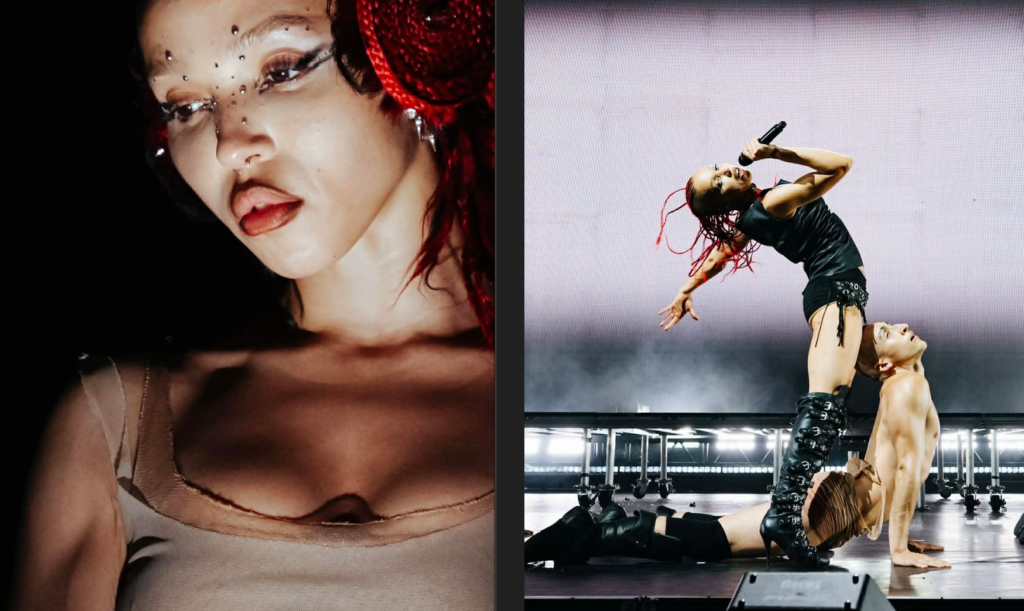
Walking into the massive venue, I felt lucky to have once seen her in the much smaller Moore Theatre, but also grateful that so many more people had now found her and were here to be part of her world. I wondered how her intimacy would translate to a room this large, but the moment the show began, that concern evaporated. You could put FKA Twigs in a stadium, and she would still find a way to make it feel personal, magnetic, and emotionally precise. From the first note to the last, she was as captivating as ever, proving once more that she transcends every terrain.
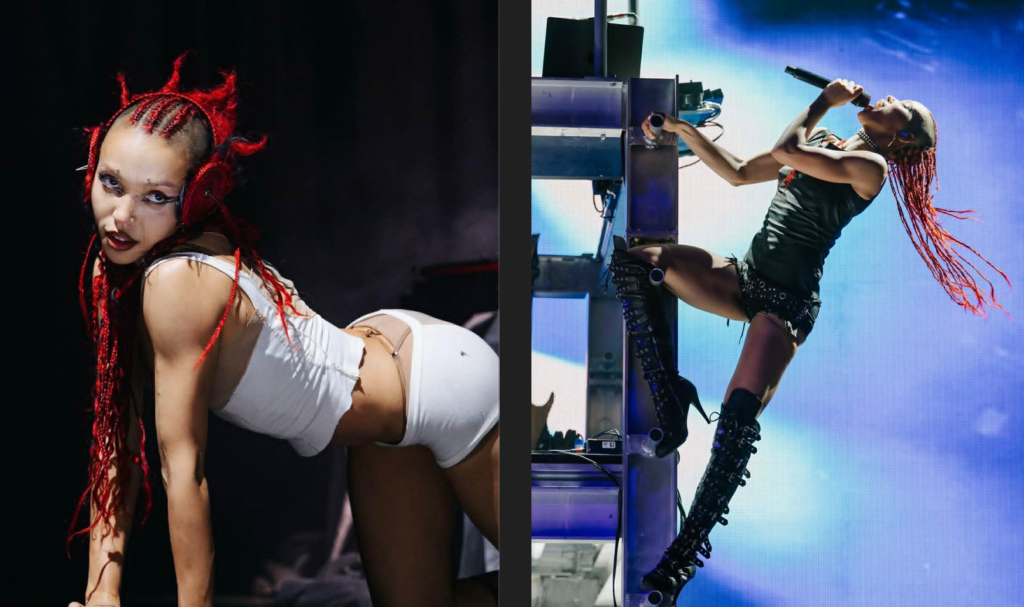
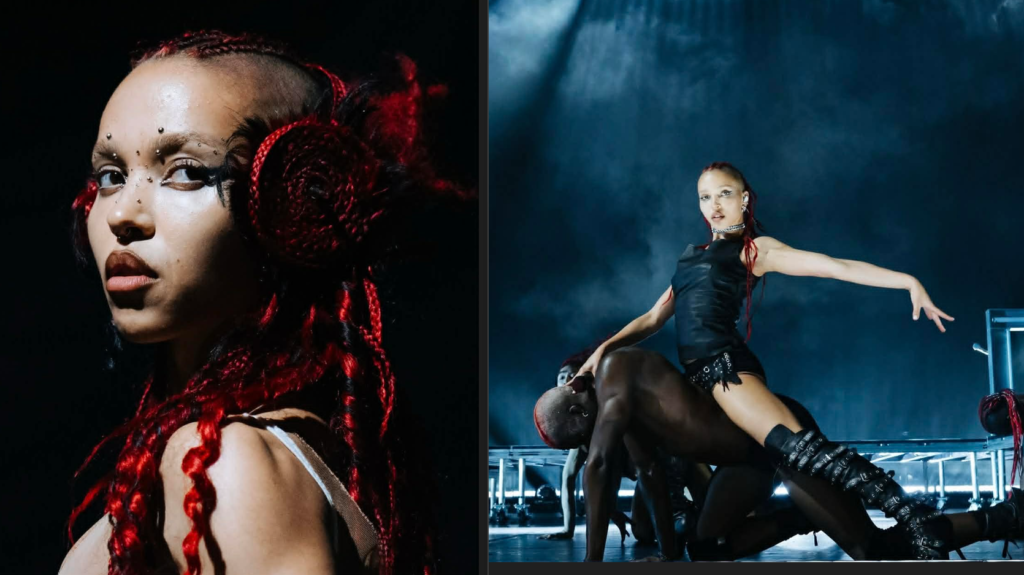
The night opened with my personal favorite, “Mirrored Heart,” a surprising but stunning choice for an opener, soft, emotional, and disarming. Twigs appeared alone in the center of the stage on a mattress-like platform with sheets, pulling the entire room inward. The first act stayed in this slower, more vulnerable space, setting up the emotional rollercoaster that would follow. As she transitioned into Act II, the shift was seismic. The beats hit harder, the choreography sharpened, and the dancers took center formation. Each performer had a hint of red in their hair, creating a mesmerizing illusion as they intertwined with Twigs, sometimes so seamlessly that it was difficult to locate her among them. This was deliberate, clever, and visually stunning.
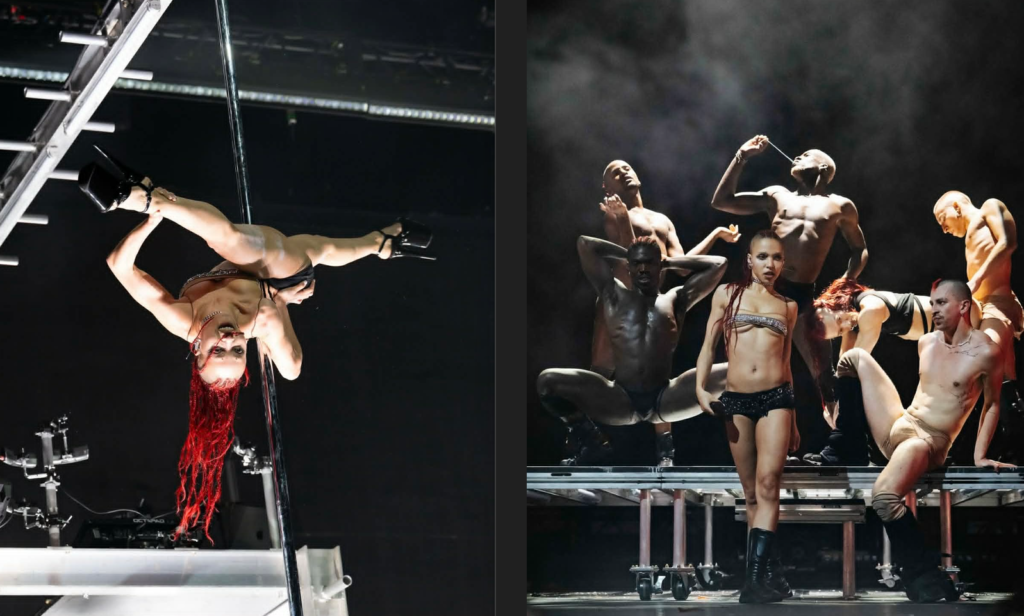
One of the most striking moments of the night came during “Video Girl.” One of the dancers carried a handheld camera, filming Twigs and the ensemble in real time. The footage was projected onto the massive screen behind them, creating a dizzying, hyper‑intimate visual loop. The videography was next‑level, grainy, chaotic, voyeuristic pulling us directly into the scene unfolding onstage. As the song reached its climax, the dancer with the camera intertwined with Twigs in the middle of the floor, their bodies weaving together in a way that blurred performer and observer, subject and lens. It was raw, cinematic, and unforgettable.
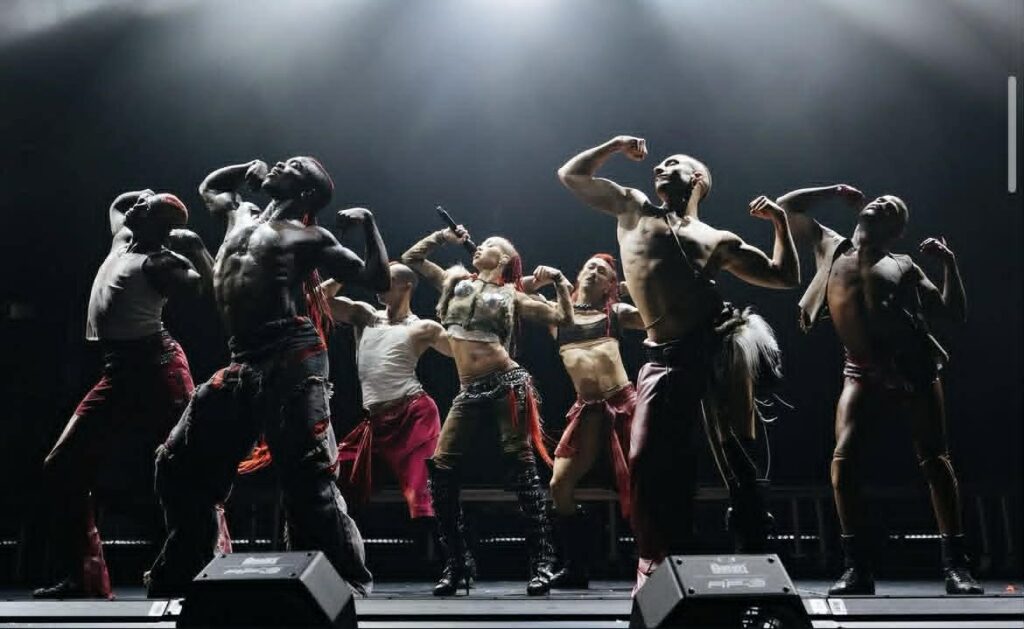
The stage design was deceptively simple at first glance: a massive screen at the back, the center of the stage kept mostly clear. But on each side stood towering metal structures equipped with poles, musicians, and dancers. At the height of the dance‑heavy numbers, the scene felt ripped from Mad Max industrial, feral, and beautifully chaotic. Their costumes matched the energy perfectly. It was art in motion, ever‑changing, ever‑evolving, and absolutely genius.
The mood of the concert swung from peaceful to violent in seconds a duality Twigs holds with divine precision. You don’t need to know her life story to understand she’s been through a lot; it’s written into every movement, every breath, every break in her voice. She embodies a perfect harmony of softness and brutality, like Themis holding both scales at once, shifting between them with supernatural ease.
This wasn’t just a concert it was a two‑hour, five‑act experience with a 31‑song setlist that left no one wanting. The visuals changed constantly, each act with its own emotional palette. After performing “Home With You,” she paused to reflect on the lyric “Never seen a hero like me in a sci‑fi” and told the crowd that this is a sci-fi. That we are all heroes in this sci-fi that we created tonight.
The main set closed with a breathtaking trio: “fallen alien,” “Mary Magdalene,” and “Thousand Eyes.” Each one landed like a spell, the room hanging on every syllable.
When she returned for the encore, she looked like a queen regal, otherworldly, untouchable. She launched into “Two Weeks,” and then moved into “Striptease,” where she slowly removed the feather‑like outfit she had been wearing since the encore began. The reveal was deliberate, sensual, and theatrical, a shedding of armor before she ascended the pole on the right side of the stage. What followed was a breathtaking pole‑dance performance, every movement controlled and expressive, the entire room glued to her. The way she moves, the way she sings, the way she pauses her voice and lets emotion spill through her body, it’s beyond performance. It’s communion.
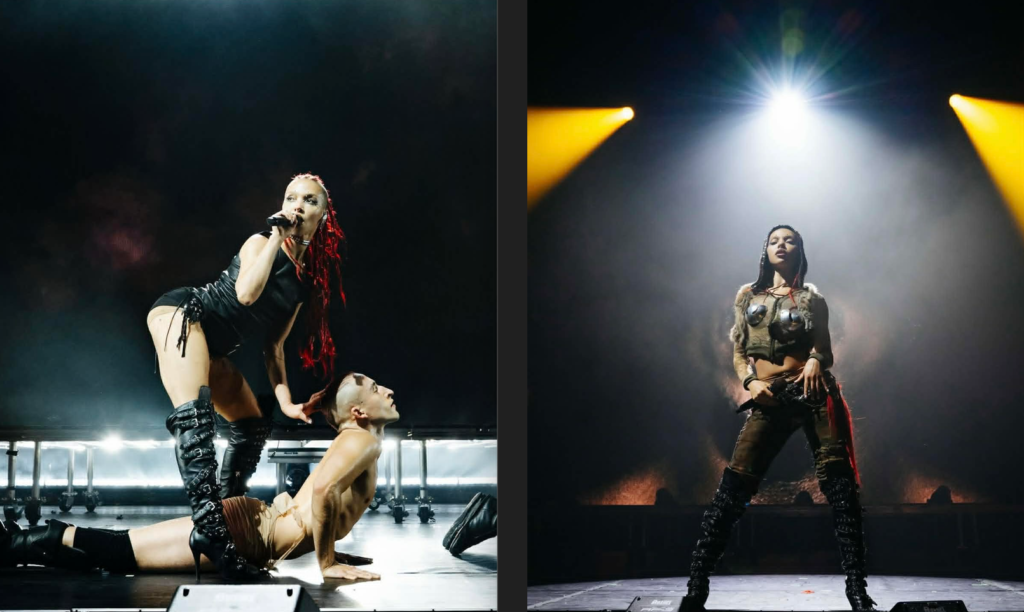
The night ended with “Cellophane.” Twigs returned to the center of the stage alone as fake snow began to fall from the ceiling, illuminated by a single spotlight. She sang “Didn’t I do it for you? Why don’t I do it for you?” and her voice broke, silenced, then rose again. Toward the end, she moved to a mattress-like prop on the left side of the stage, curled into herself, and repeated the chorus. Each line felt like a scar appearing on all of us; each exhale felt like she was erasing it.
There is no one like her. Witnessing her perform again made this even more apparent. FKA Twigs is so much more than an artist, she is a mastermind, creating something idiosyncratic and alive in real time every time she steps onstage. Proving once again that she is one of a kind, unrepeatable, creating magic we all need in this world.
Photos by: Dana Jacobs @picsbydana from San Francisco